January 31, 2026
Most B2C companies have zero visibility into the emails, SMS, and push notifications competitors send to real customers. Direct Communication Intelligence changes that.
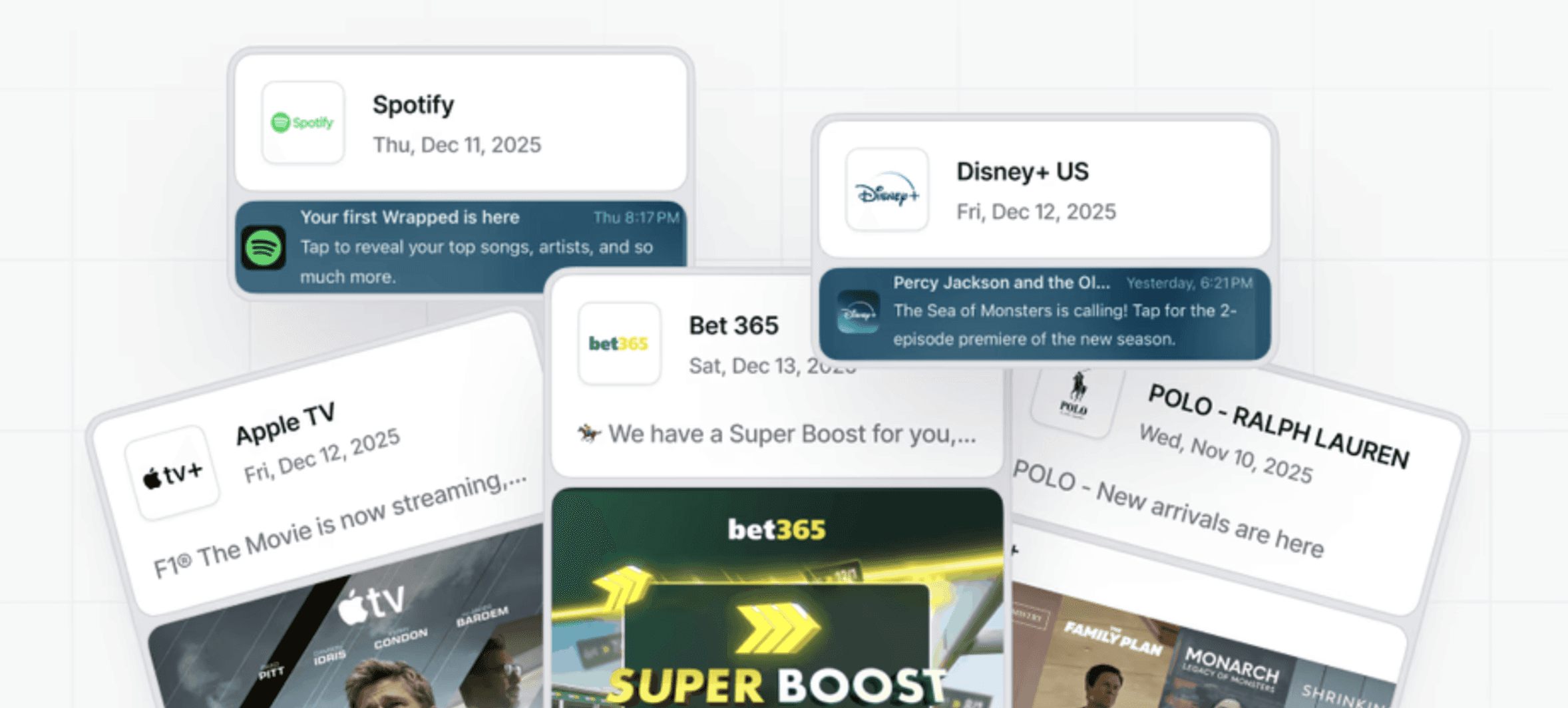
Most B2C companies spend millions on competitive analysis. They track ad spend. They monitor social media. They scrape websites for pricing changes. And they still have no idea what those competitors are actually saying to their customers.
Not what they post publicly. What they send privately: the emails, the SMS messages, the push notifications that reach real customers every single day. The retention offers. The reactivation sequences. The lifecycle campaigns. This is the largest competitive blind spot in B2C marketing, and it has a name: the Direct Communication Intelligence gap.
The Blind Spot No One Talks About
A typical B2C marketing team has a detailed view of what their competitors do in public. They can analyze display ads through ad intelligence platforms. They can monitor social media mentions. They can visit a competitor's website and track pricing changes. They can sign up for a competitor's service and see what one user, in one segment, in one market receives.
What they cannot see is the actual direct communications a competitor sends across all customer segments, all markets, and all stages of the lifecycle.
The retention offers going to high-value customers about to churn. The reactivation sequences targeting lapsed users. The onboarding flows designed to convert trial subscribers into paying customers. The promotional campaigns timed to specific events, seasons, and competitive moments.
This is where the real competitive strategy lives. Not on a website. Not in a display ad. In the inbox. In the push notification tray. In the SMS thread. Direct communication channels are where customer lifetime value is built, defended, and lost. And there has been no systematic way to see what competitors are doing in them.
Why This Matters More Than Ever
Three trends are converging that make Direct Communication Intelligence not just useful, but essential.
Direct channels have become the primary battlefield for retention. In industries like iGaming, streaming, telecommunications, and subscription services, the CRM team's ability to retain, reactivate, and upsell customers through direct communication is often one of the largest drivers of profitability. Yet most teams build these campaigns in a vacuum, with no visibility into what the best operators in their market are doing.
The sophistication gap between leaders and laggards is widening. The brands with the most advanced CRM operations are pulling further ahead, testing more, segmenting more, personalizing more, and optimizing at a pace that competitors cannot match without visibility. Companies that operate without competitive benchmarks are not just falling behind. They don't know how far behind they are.
The speed of competitive shifts is accelerating. A competitor can launch a new offer structure, change their pricing communication, introduce a bundling strategy, or deploy an entirely new reactivation approach in days. Traditional competitive monitoring (manual audits, quarterly reports, ad hoc research) cannot keep pace. By the time a periodic report lands on a desk, the landscape has already shifted.
Direct Communication Intelligence (DCI) is the ability to see, analyze, and benchmark the actual communications that brands send directly to their customers, across email, SMS, push notifications, and in-app channels, in real time, across multiple markets, segments, and lifecycle stages.
It is not ad intelligence, which tracks paid media. It is not social listening, which monitors public mentions. It is not website monitoring, which tracks visible changes. And it is not the limited view you get from signing up for a competitor's service yourself: one person, one segment, one market.
DCI provides the full picture: what competitors are sending, to which customer segments, in which markets, through which channels, at what frequency, and with what messaging and offers. It is the complete view of a competitor's direct engagement strategy, sourced from real consumer data shared with explicit consent.
Five Use Cases That Drive Immediate Value
Competitive benchmarking that goes beyond guesswork. Most CRM teams have no external reference point for their communication strategy. They don't know if they're sending too many messages or too few, whether their offers are competitive or outdated, whether their lifecycle sequences are sophisticated or basic compared to the market. DCI answers the question every CRM leader asks but has never been able to answer: where do we stand relative to our competitors?
Detecting competitive shifts before they impact your business. When a competitor launches a new loyalty program, restructures their retention offers, or rolls out an aggressive win-back campaign, DCI surfaces it as it happens, not weeks later when the impact shows up in your churn numbers. Teams can respond to competitive moves in days, not months.
Informing campaign strategy with real-world evidence. Instead of guessing which onboarding flow will convert best, teams can see how the leading brands in their industry structure theirs. Instead of theorizing about the right reactivation cadence, they can analyze what is actually working. This is not about copying. It is about making informed decisions with real data rather than assumptions.
Supporting new market entry with local intelligence. Expanding into a new geography is one of the highest-risk moments for any B2C company. Competitive dynamics, communication norms, and customer expectations vary significantly by market. DCI provides local competitive context before the first campaign is ever sent.
Validating strategic decisions. CRM and marketing leaders are constantly asked to justify their strategies. Why this offer structure? Why this send frequency? Why this channel mix? With DCI, the answer is grounded in market reality rather than intuition.
There is a growing divide between companies that have systematic visibility into their competitive communication landscape and those that do not.
Companies with visibility make faster, better-informed decisions. They catch competitive shifts early. They benchmark against real market data. They spot untapped opportunities that others miss. They build CRM operations that are genuinely strategic, not reactive.
Companies without it are operating on intuition and incomplete information, discovering competitive threats after the damage is done, with no way to know what they don't know.
As direct communication channels become more central to B2C business performance, this divide will only grow.
Moving from Blind Spot to Strategic Advantage
Your competitors' direct communications to their customers are one of the most important expressions of their competitive strategy. You should be able to see them. Not partially. Not occasionally. Continuously, across all channels, all markets, and all segments that matter to your business.
This is what Direct Communication Intelligence provides. It takes one of the last remaining blind spots in competitive analysis and turns it into a source of strategic advantage.
Your competitors are communicating with your current and potential customers millions of times per day. The question is whether you know what they're saying, and whether that knowledge is shaping your strategy.
For a growing number of B2C companies, the answer is yes. For everyone else, the blind spot remains.
About Axess Intelligence
Axess Intelligence pioneered the Direct Communication Intelligence category. The platform captures real emails, SMS messages, push notifications, and in-app communications across 5,000+ brands in 50+ markets. Request a demo at axessintelligence.com/demo to see what your competitors are sending.